In the world of professional monitors and HDR monitoring, “dynamic contrast” often appears in technical specifications with exceptionally high figures. For imaging professionals, this technology can help LCD displays overcome some of their inherent black-level limitations. At the same time, it is a key test of a manufacturer’s engineering and calibration expertise.
Traditional LCD panels are constrained by the characteristics of liquid-crystal technology, which can make blacks appear gray. Enabling dynamic contrast can produce deeper blacks, but it may also introduce backlight fluctuations, color shifts and haloing—issues that can seriously affect how creators judge an image. How can these competing demands be balanced? This article examines the underlying principles of dynamic contrast, objectively explains what the technology does, and clarifies how it differs from static contrast, providing a reference for professional imaging users and advanced display enthusiasts.
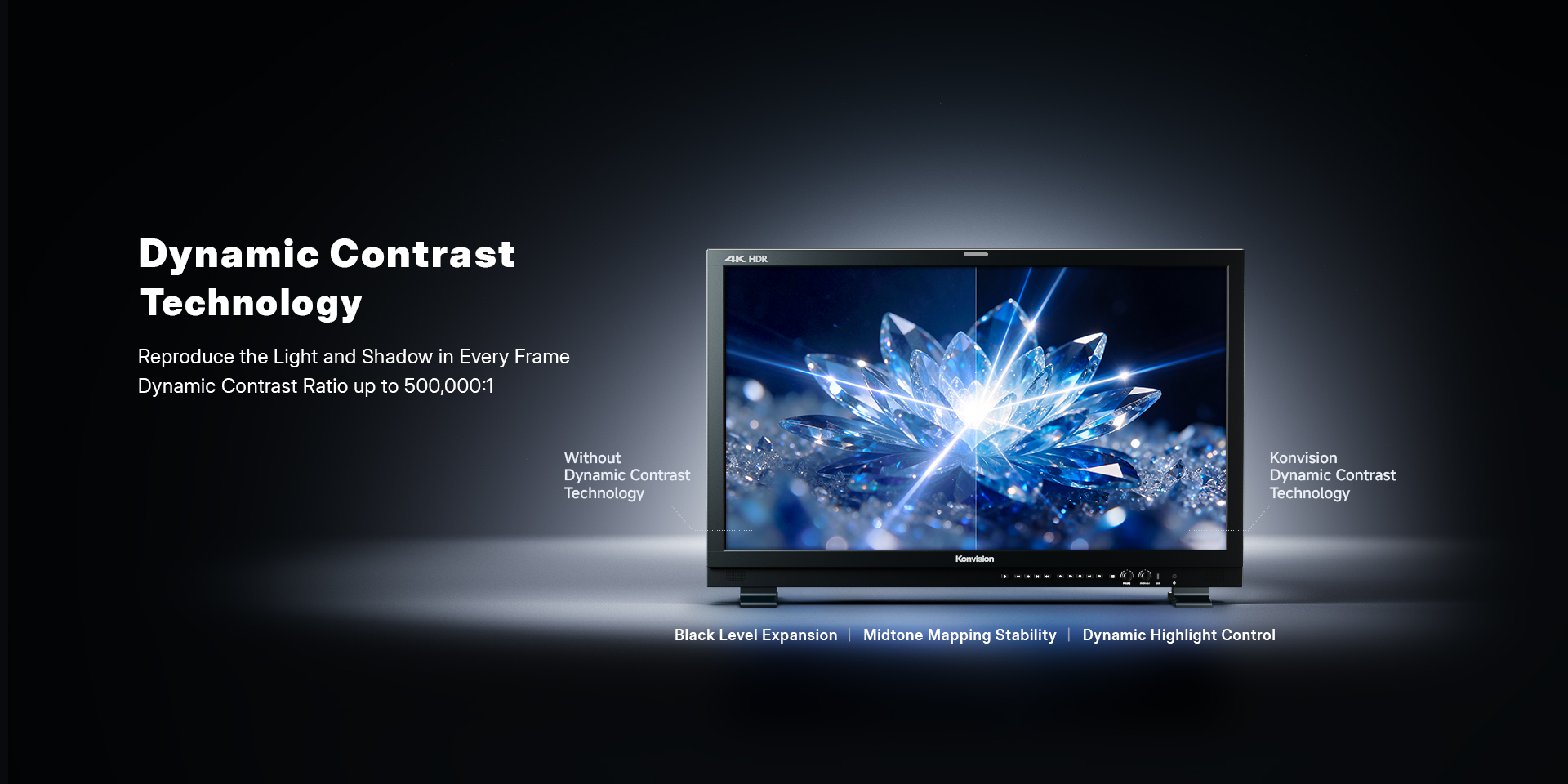
1. Understanding the Difference Between Static and Dynamic Contrast
In display specifications, contrast ratio is the ratio between the luminance of white and black. A higher ratio can help reveal greater tonal separation. To understand dynamic contrast properly, it is important to distinguish between two different types of contrast measurement.
Also known as the native contrast ratio, static contrast is a fundamental measure of a display panel’s physical performance. It describes the difference between the brightest white and darkest black the panel can reproduce without relying on dynamic adjustment technologies.
· Measurement method: The ANSI checkerboard method is commonly used. A pattern of alternating black and white squares is displayed simultaneously, and the luminance of the white squares is compared with that of the black squares. This method more closely reflects real-world viewing conditions.
· Typical figures: IPS panels typically deliver a static contrast ratio of around 1,000:1, while VA panels generally achieve higher figures, often 3,000:1 or more.
· Significance: Static contrast is a key factor in baseline image quality. A higher native contrast ratio can provide cleaner blacks and more visible shadow detail plus solid color reproduction. It is particularly important in color grading, post-production and professional image processing, where accurate image reproduction is essential.
Dynamic contrast is the peak contrast ratio a display or monitor can achieve by dynamically adjusting backlight output or applying signal processing as the displayed content changes. The underlying principle is to analyze image content and adjust luminance in real time to enhance the perceived difference between bright and dark scenes. For example, the backlight may be dimmed when a predominantly black image is displayed to produce deeper blacks, and increased in a bright scene to reproduce highlights more prominently. Dynamic contrast figures are usually much higher than static contrast ratios and can reach the million-to-one range, such as 1,000,000:1.
· Measurement method: The Full On / Full Off (FOFO) method is commonly used. The maximum luminance is measured with the entire screen displaying white, followed by the minimum luminance with the entire screen displaying black. The two measurements are then divided.
· Typical figures: One million to one or higher.
· The essence: Dynamic contrast is not an inherent property of the panel. It is an enhancement achieved through system-level control. It does not represent the range of bright and dark levels that can be reproduced simultaneously within a single image, and is often presented as a peak specification. In professional monitors, however, backlight control based on frame-by-frame image analysis can deliver a meaningful improvement in contrast. The relevant technical approaches are explained below.
Type | Measurement method | Key characteristics |
Static contrast (native contrast) | ANSI checkerboard pattern (16 alternating black and white squares) | Reflects the panel’s inherent physical performance. Typical figures are lower—usually around 1,000:1 to 3,000:1—with IPS panels generally lower and VA panels generally higher. |
Dynamic contrast | FOFO (Full On / Full Off), using full-screen white and black | Achieved through dynamic backlight adjustment. The resulting figures can reach the millions-to-one or even higher. |
The core mechanism behind dynamic contrast is dynamic backlight dimming: the display adjusts backlight output in real time according to the brightness characteristics of the image.
1. Image analysis: The imagine processor inside the monitor analyzes the incoming video signal in real time to determine the overall brightness level of the current frame.
2. Backlight adjustment:
· Predominantly dark images: For a dark scene, such as a night shot, the system automatically reduces backlight output to produce deeper blacks.
· Predominantly bright images: For a bright scene, such as a daylight shot, the system increases backlight output—up to its available maximum—to reproduce highlights.
Example: If a panel has a native contrast ratio of 500:1 and the backlight is reduced to one-fifth of its original level when displaying a full-black image, the dynamic contrast ratio can reach 2,500:1.
Static contrast affects the fundamental image quality of a display. A higher native contrast ratio can improve detail reproduction, making it ideal for professional image editing, post-production, and other demanding applications.
Dynamic contrast can enhance visual impact and is commonly used in entertainment applications such as movies and gaming. However, depending on the implementation, it may compromise color accuracy or image stability—for example, backlight fluctuations can cause color shifts. In professional monitors, frame-by-frame backlight control can keep such variations within an acceptable range for monitoring.
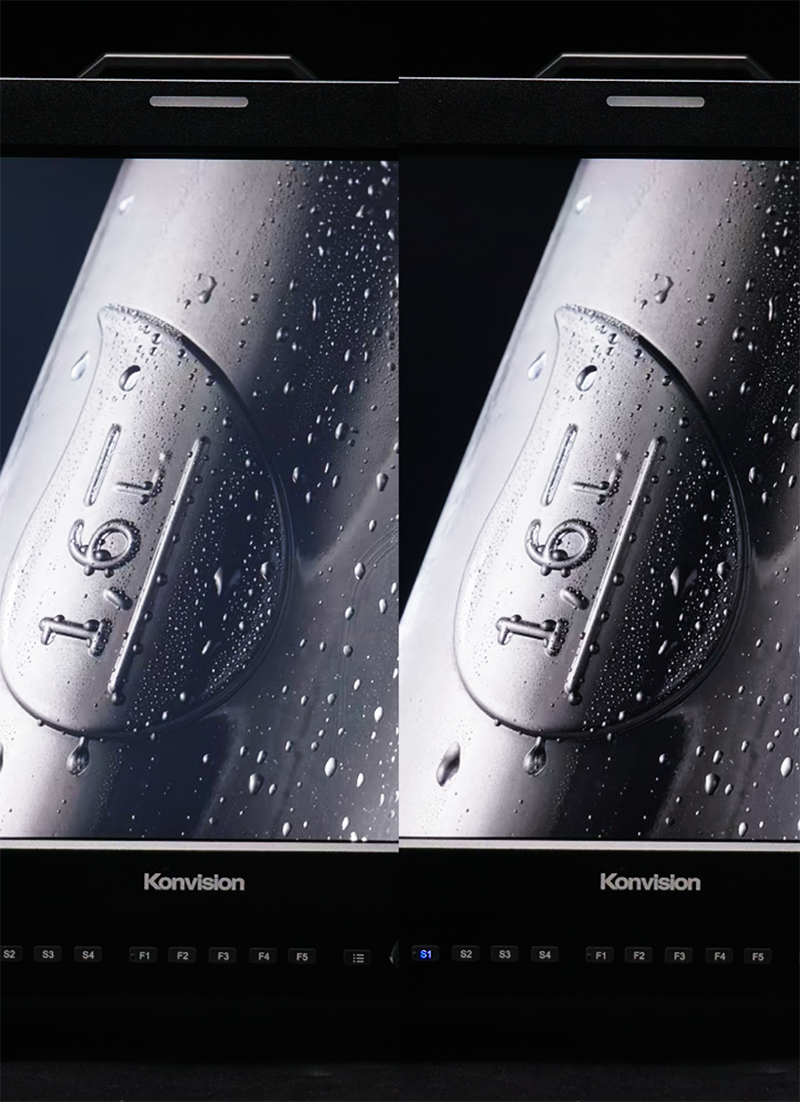
There are two principal approaches to dynamic backlight control in the display industry. Their performance can differ significantly in professional monitoring environments.
The entire screen’s backlight is treated as a single unit, with its brightness adjusted uniformly.
· Advantages: Relatively simple technology and lower implementation cost.
· Limitations: Conventional global dimming, which simply raises or lowers the output of the entire backlight, has limited effectiveness. When very bright and very dark areas appear in the same frame—for example, a city beneath a star-filled sky—the system cannot optimize both independently. Highlights may appear insufficiently bright, blacks may not be deep enough, or the overall image brightness may visibly shift.
In high-end film and broadcast HDR monitoring, global backlight control is not necessarily limited to the basic approach described above. Professional monitors can use dynamic contrast technology to evolve global backlight control into a frame-by-frame system. Its workflow is as follows:
· Frame-by-frame analysis: The monitor’s imagine processor analyzes every incoming frame, calculating the average picture level (APL) and the distribution of luminance.
· Global adjustment: Based on the analysis, the system adjusts LED backlight output across the entire screen in real time, rather than driving separate zones independently.
· Adaptive response to image brightness: For dark scenes with a low APL, the backlight is automatically reduced to suppress light leakage through the LCD layer and produce cleaner blacks. For bright scenes with a high APL, the backlight is increased to reproduce specular highlights of up to 1,000 cd/m².
The combination of pixel-level modulation by the liquid-crystal layer and global backlight modulation enables LCD technology to achieve a dynamic contrast ratio of up to 1,000,000:1.
More importantly, this approach is well suited to professional monitoring. Because the backlight is adjusted uniformly across the screen, it does not create zone-based halos, and screen-wide brightness uniformity is maintained. Gamma characteristics remain unchanged during adjustment, helping preserve color accuracy. Colorists can therefore use the monitor with confidence when evaluating the overall balance between highlights and shadows.
The backlight module is divided into multiple independently controlled zones. Each zone adjusts its brightness according to the image content in the corresponding area of the screen.
· Advantages: Local dimming can significantly improve perceived contrast and HDR performance, particularly in scenes with complex lighting and a wide range of brightness levels.
· Technology evolution:
LED local dimming: A widely used approach today, with implementations ranging from dozens to hundreds of independently controlled zones.
Mini-LED: A high-end LCD backlight solution featuring thousands or more dimming zones. Its finer control can substantially reduce haloing and bring LCD image quality closer to that of OLED.
OLED: As a self-emissive technology, OLED can switch each pixel on or off independently. This provides pixel-level light control, giving OLED a theoretically infinite contrast ratio.
· Limitations: Haloing can occur around the boundaries between dimming zones. Brightness fluctuations caused by independently controlled zones may also affect monitoring judgments. Zone-based systems therefore require careful balancing of zone count, dimming algorithms and halo suppression.
Backlight technology | Potential dynamic contrast ratio | Notes |
CCFL backlight with local dimming | Approx. 150,000:1 | Earlier-generation technology |
LED backlight with local dimming | Approx. 1,000,000:1 | Commonly used approach today |
Mini-LED backlight (thousands of zones) | Several million:1 | High-end LCD solution |
OLED (self-emissive pixels) | Theoretically infinite:1 | No backlight required; individual pixels can be switched off |
The core of a local-dimming algorithm is to determine the backlight level for each zone based on the characteristics of the input image. Common backlight extraction algorithms include:
Algorithm | Principle | Characteristics |
Maximum (Max) | Uses the maximum pixel value within a zone | High luminance fidelity, but higher power consumption |
Average (Avg) | Uses the average pixel value within a zone | Simple to implement, but may lose shadow detail |
Root mean square (RMS) | Uses the RMS value of the pixels within a zone | A compromise between the Max and Avg methods |
Error correction (Diff) | Iteratively corrects based on luminance error | Can provide good image quality |
Pixel compensation: When backlight output is reduced, the LCD panel’s transmittance must be increased to compensate for the resulting loss of luminance. The relationship can be expressed as:
Tcomp=(BFullBHDR)1/γ⋅TtargetTcomp=(BHDRBFull)1/γ⋅Ttarget
Where BFull is the maximum backlight luminance, BHDR is the backlight luminance after dimming, and γ is the gamma value.
The impact of dynamic contrast technology varies significantly depending on the application.
When reviewing finished content or watching entertainment material, dynamic contrast—particularly local dimming—can enhance visual impact. It can make bright scenes more striking and dark scenes more defined, adding depth and immersion while helping HDR content demonstrate its visual range.
In professional workflows such as film and post-production and color grading, it is important to distinguish between display types. Dynamic contrast implementations in consumer-grade displays may introduce unwanted effects. Potential risks include:
Unstable brightness: Automatic changes in backlight output can interfere with accurate exposure evaluation.
Reduced color accuracy: Changes in backlight output may cause color shifts and compromise color fidelity, conflicting with the professional display principle of “what you see is what you get.”
Loss of detail: Aggressive algorithms may sacrifice some shadow or highlight detail in an attempt to increase contrast.
For this reason, displays often provide an option to disable dynamic contrast, helping preserve the original signal appearance and image stability. It is important to note that these concerns mainly apply to consumer-grade local-dimming implementations or aggressive algorithms. Professional monitors using frame-by-frame global backlight control can be engineered to maintain gamma characteristics and chromaticity uniformity. This approach is designed for professional monitoring and can be used during HDR monitoring when properly implemented.
In film and post-production, dynamic contrast is a technology to be managed—not blindly relied upon.
Primary principle: On a reference-grade professional monitor, properly calibrated dynamic backlight control can be part of an accurate HDR monitoring workflow and may remain enabled throughout. On a consumer-grade display, it is generally advisable to disable dynamic contrast enhancements during critical tasks such as color grading and quality control (QC), in order to maintain a clean and stable monitoring signal.
Technology recognition: Determine whether the monitor uses global dynamic backlight control or local dimming. Check whether the dimming algorithm is engineered for professional monitoring, and whether haloing and brightness fluctuations are adequately controlled. This helps avoid misjudging image details.
Equipment selection: When selecting a post-production reference monitor, prioritize native static contrast, color gamut coverage and color accuracy. Local dimming and OLED can be valuable advantages, provided halo control meets professional requirements and the relevant enhancement functions can be fully disabled.
In film and post-production, “dynamic contrast” has long been used as a marketing term. Behind figures in the millions or tens of millions, implementations may involve backlight fluctuations, color shifts and haloing. For colorists and post-production teams who depend on “what you see is what you get,” these unstable enhancements can interfere with critical monitoring decisions.
Konvision’s new generation of 4K and 8K professional monitors uses a global dynamic backlight control approach based on frame-by-frame average picture level analysis. The system analyzes the luminance level of each frame and dynamically controls the LCD backlight across the entire screen. In dark scenes, it automatically reduces backlight output to produce cleaner blacks; in bright scenes, it increases backlight output to preserve highlight detail. The maximum dynamic contrast ratio reaches 500,000:1.
Unlike local enhancement solutions that rely on zone-based backlighting, this approach does not produce zone-related halos or disrupt the overall tonal balance due to isolated bright zones. Through coordinated control of the backlight, gamma and color, it also maintains stable grayscale relationships, color accuracy and signal-level correspondence. This allows dynamic contrast enhancement to serve the needs of professional monitoring, supporting the “what you see is what you get” requirements of color grading, content review and high-quality image evaluation.
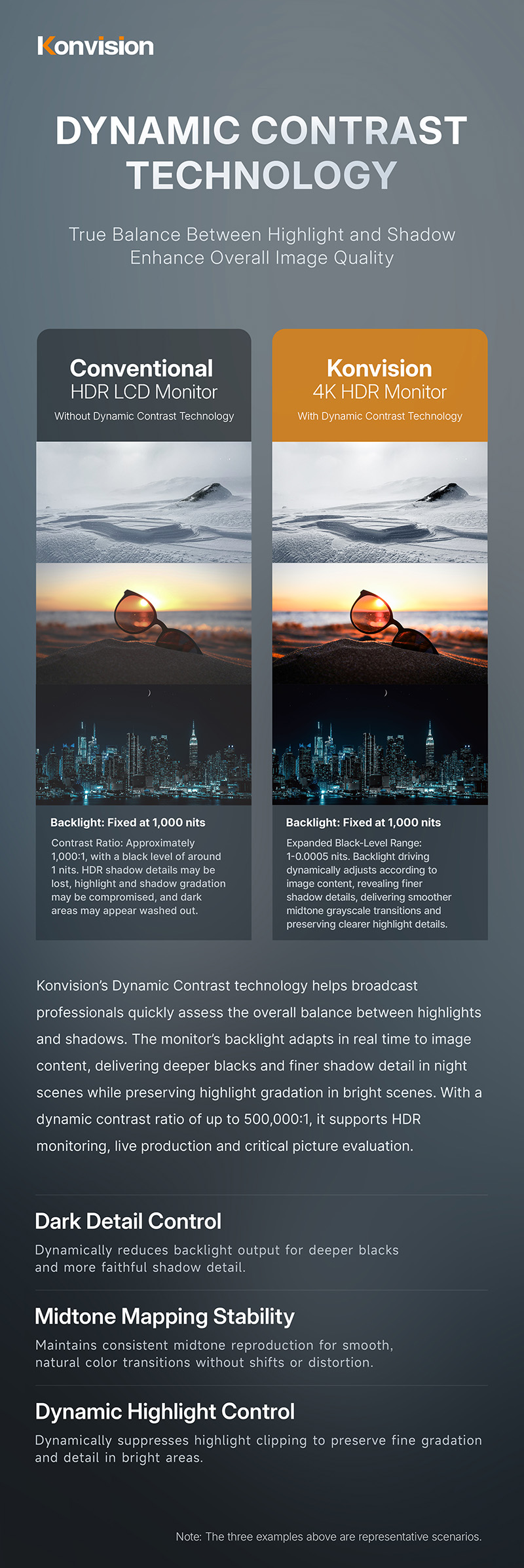
Konvision has implemented this frame-by-frame global dynamic backlight technology across its new generation of 4K and 8K professional monitors. The product portfolio spans three categories—4K, 8K and IP—providing monitoring solutions for HDR production workflows of different scales.
4K Monitors | 8K Monitors | IP Monitors |
Dynamic contrast is never simply a marketing specification. Its real value depends entirely on the backlight architecture and the quality of the control algorithms and engineering calibration.
For professional LCD monitors, carefully engineered frame-by-frame global backlight control can unlock more of the display’s HDR monitoring capability, helping production teams evaluate the full range of image tones—from deep blacks to bright highlights. At Konvision, the focus is not on chasing headline-grabbing numbers, but on refining the underlying light-control technology through rigorous engineering.
When the black-level limitations of LCD are no longer an insurmountable boundary, professional monitoring can deliver an even more dependable “what you see is what you get” experience.
Shenzhen Konvision Technology Co., Ltd.


